Colonial Spanish Balconies, Eyeglasses Ceremony, Camu-Camu, and Chancaca Molasses

7 January 2018

Part of the joy of living in Lima is the amount of Spanish culture and colonial architecture. It often feels more Spanish here than in Spain! This is an interesting place to serve a humanitarian mission.

Spanish colonial balconies in Lima - hundreds were built between the 1600s to the 1800s. In certain places, it feels like being in Europe. (Note the satellite dishes hanging from the sides of these historic balconies).

Spanish balconies are maintained all around Lima - a reminder of the days gone by.

Final Trip to Pucallpa


Our trip to Pucallpa on Christmas Day was supposed to include a delivery ceremony for the thousand eyeglasses we donated. However, at the last minute, the ceremony was postponed because the remodel work on the school wasn't finished. They rescheduled for this week and then Moroni Torres, the Area Welfare Manager in our office, decided I would accompany him. (Sandy got to stay in Lima and avoid the 18-hour day trip).

Ucayali River in the Amazon basin. View from our plane at 6 a.m. just as the morning river fog was burning off the jungle at daybreak.

Government and school officials, as well as other health authority leaders, gathered at one of the 41 schools where students were receiving the eyeglasses in order to hold the ceremony.

A few of the eyeglasses for the delivery ceremony - a thousand children were measured two weeks previous and now have received the eyeglasses to help them see.

Children and their parents at the ceremony to receive the donation of glasses.

Children received their eyeglasses as part of the ceremony.

Our area welfare manager, Moroni Torres, and one of the students who received the eyeglasses. The kids all got to pick their own frames, so this should encourage them to wear the glasses.

Ceremonies are extremely important to Peruvians, especially the formality of a delivery ceremony. First, it formalizes the donation and lets everyone know the importance of maintaining the items. Next, it gives a chance for health officials, government leaders, and others to give speeches in front of crowds. And finally, it is a chance to celebrate (which Peruvians especially love). The children received their eyeglasses, leaders gave their speeches, and everyone got to party with three bands of traditional music. It was a great day.

Various traditional music groups of the jungle performed. They make their own flutes out of plastic tubing so they won't rot in the high humidity of the jungle.

Live traditional music made the event even more fun.

We always team up with local partners on our humanitarian projects. Why? Because we can do things as a team that we can't do on our own. For example, on this donation of eyeglasses, we could donate the eye exams and the eyeglasses themselves for a thousand children. But, we couldn't perform the screening on the 10,000 students in each of their schools in order to select the 1,000 that needed glasses. Also, we couldn't distribute all the glasses to children in 41 schools. Our partners in the regional government and health authority had to help with all of that coordination.

Moroni Torres and I, along with our partners at the Ucayali regional government and the Direccion Regional de Salud (the regional health authority) who helped make this vision campaign a success.

Jungle Fruit - Camu-Camu


Many fruits here in Peru never make it out from the jungle to the cities due to lack of transportation, spoilage, etc. When we go to the jungle, we try all the incredible fruits that are almost never found in Lima. One of them is camu-camu.

Camu-camu - fruit found only out in the jungle.

Camu-camu is the most tart fruit I have ever tasted. It is somewhere between the taste of a lemon and cranberries. Usually, they take the juice of the fruit and turn it into an incredible drink by adding lots of sugar (like lemonade).

Refreshing camu-camu. With enough sweetener, it looks and tastes like pink lemonade.

On our last two trips to Pucallpa, we saw the camu-camu orchards and ate the fruit right off the tree (like eating a whole pack of SweetTarts in every bite). 

The camu-camu plant grows in low jungle areas that are often submerged under water. The local Indian communities harvest the fruit in canoes during the wet season.

Orchard of camu-camu in Pucallpa. The trees are partially submerged by high water from the Ucayali River.

Local Indian groups harvest the camu-camu fruit in these homemade canoes.

And, as the waters continue rising in the Ucayali River, most of the stilt houses will be up to their front doors in river water in the next few weeks, just in time to start harvesting the camu-camu.

The waters are already rising along the river. Thank goodness for the stilts that will hopefully keep these houses dry.

Make your own Molasses


Some food items we take for granted in the USA are really hard to find here in Peru. Molasses are one of those items.  But, now we can make our own molasses from a product commonly found here called "Chancaca", which is a by-product of refining sugar cane.

Raw sugar chancaca in a molded shape the size of a cupcake.

Chancaca is poured into molds as part of the manufacturing process. After they cool down, they wrap up eight of these molded sugar cakes in strips of palm leaves and sell them in markets.

Chancaca wrapped up in strips of palm leaves for sale. Each package contains eight molded chancaca cakes.

We buy chancaca in local markets, then take it home for making molasses. The bag shown here contains eight molded sugar cakes and costs around $5 USD.

To make molasses, you put a cake of chancaca into a pot, mix in a little water, then boil it for 10 or 20 minutes. The result is thick and very tasty molasses.

Boiling chancaca to make our homemade molasses

We can also make brown sugar (which is impossible to find in Peru) by mixing a tablespoon of molasses with a cup of white sugar. Ah, nothing is impossible here, given a little bit of experimenting.  


And so our next week promises to be full of more adventures as we press on with the many projects that are awaiting us. We like the work here and count it a privilege to be able to serve.

Delivery - Pucallpa Jungle Vision Trip

1 January 2018

We welcomed in the New Year on a new continent and in a different hemisphere for our first time last night. Fireworks went on for hours, and the music and dancing outside our apartment didn't calm down until around 6 a.m. (these people love to party). As we greet the new year, we are reminded that our many humanitarian projects promise to keep us very busy for the remaining 7 months of our mission.

Our main activity this past week was returning to the jungle city of Pucallpa to make a donation of a thousand eyeglasses to children as part of our vision project.

Pucallpa, on the edge of civilization, is surrounded on all sides by jungle. Our vision project concludes with this donation of a thousand eyeglasses for children.

Getting to Pucallpa involves a flight over the Andes Mountains and out into the Amazon River basin.

Christmas in the Jungle - Eyeglasses to Pucallpa


We flew out from Lima on Christmas night to reach the jungle city of Pucallpa and make a time-critical delivery of a thousand eyeglasses for children. (Imagine spending part of your Christmas in a hot and steamy jungle city.)

The children had been measured previously in Pucallpa, but we had the eyeglasses manufactured in Lima and shipped by air cargo to be delivered before December 29 (the last day of the school year). Our job was to pick up the eyeglasses and deliver them to the health officials so they could distribute them.

Unfortunately, the air cargo office was closed by the time our flight arrived at 10 p.m. Christmas night, so I had to catch a taxi early the next morning to return to the airport and retrieve the six big boxes of eyeglasses. Back at our hotel, the local health authorities dropped by after I returned, and we opened the boxes to verify the contents and handed them over. Their job now is to distribute the eyeglasses to the children in 41 schools over the next few days.

After picking up the shipment of eyeglasses from air cargo, Marshall and Mercedes Villacorta from the Ucayali Region Direccion Regional de Salud (DIRESA), the regional health authority, opened the boxes to verify the donation of the thousand eyeglasses. 

The donation of eyeglasses will help children see better and hopefully succeed in school.

We were a little nervous loading all the glasses into the back of the motortaxi, but that is how people get around in this city. The cost of the eyeglasses themselves, not including the cost of the exams, amounted to about $15,000. We hoped nothing would happen en route as they were transported in such a flimsy method, but everything worked fine with the transfer.

Donation of a thousand eyeglasses loaded onto the back of a motortaxi. That is how people get around most of the time in this jungle city.

Many families struggle to put food on the table - glasses for kids are beyond their means. This donation will help those most in need. We are pleased we finally have this project ready to close - it has been lingering for 3 years. Personnel changes with our government partners at the health authority caused this delay, but everything has now finally been brought to completion (thanks to lots and lots of coordination and phone calls over the past few months).

Around Pucallpa


Due to being so far from civilization, it is cheaper to get three-wheeled motorcycles into Pucallpa than cars or trucks. Everywhere you go in Pucallpa there are the motortaxis. They are a cheap (and refreshingly cool) way to get almost anywhere in town - cost is between $1 and $2.

Motortaxis in Pucallpa - open air transportation is a welcome relief in this hot and steamy jungle city.
.
It rains everyday in the jungle, so drivers are prepared to put up their rain guards - just a sheet of plastic.

Into the Jungle


Jungle surrounds this city on all sides. Pucallpa is at the edge of civilization - the road connecting to the rest of Peru ends in Pucallpa.

Houses built anywhere near the Ucayali River are built on stilts because the river rises 12 feet or more during the rainy season.

Most of the roads near the river are submerged for part of the year - the only way to your house is by boat. Wooden bridges carry motortaxis over roads that are otherwise muddy year round.

Most areas near the river have elevated walkways to get around town when the river rises.

Elevated walkways keep you dry and out of the mud when the river rises.

Any journey beyond Pucallpa is on the Ucayali River, one of the two main rivers that form the Amazon. Travel beyond Pucallpa is always by boat.

The roads end in Pucallpa. Beyond the city, everything travels by boat. Here a family travels by long canoe back to town on the Ucayali River.

This is a typical family vehicle if you live outside the city - a dugout canoe. Just make sure to bring along a pitcher to bail out the water that leaks in.

We had a few free hours after delivering the eyeglasses, so we went out into the jungle to experience this hot and steamy place first hand.

We took a 2-hour tour on the Ucayali River on one of these river boats. They are actually long canoes with a sunshade canopy and a motor.

The view as we started our journey. Homes built near the Ucayali River are on stilts to keep them out of the water during the wet season.

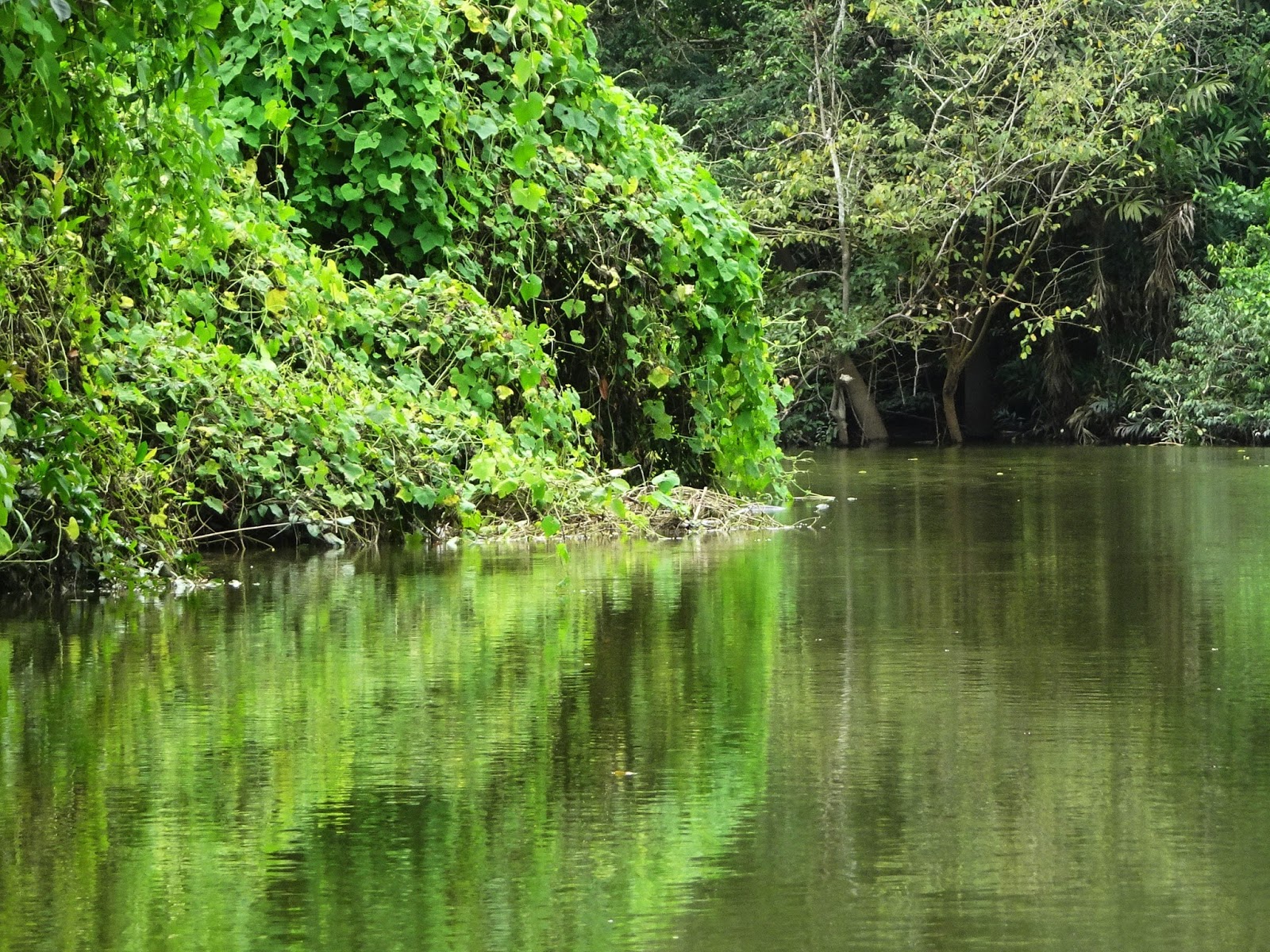
As we traveled along the Ucayali River, we ventured into side channels.The jungle is just a massive wall of green, and surprises seemed to be around every bend of the river. The jungle was alive with birds, animals, and, of course, lots of bugs.  

Tree Sloths in the Jungle


During our journey into the jungle, we spotted several tree sloths hanging from trees near the river shore. Our guide had to point them out to us because they were so well camouflaged. They move incredibly slow and their fur matches the color of the tree branches so they are hard to see. In Spanish they call them 'osos perezosos', which translates into something like 'slowpoke bears'.

One of several wild tree sloths we saw hanging from trees near the river bank. They look like they have smiles on their faces - theirs must be a good life.

We pulled up to a river village, and jungle kids came running out to see us. They excitedly brought along their pet baby tree sloths to show us.

Jungle kids showing off their pet tree sloths that they collected in the jungle.

The baby sloths were soft and cuddly, sort of like holding live, slow moving teddy bears.

The kids care for their pets, feeding them the same leaves the adult sloths eat out in the jungle. They release them when they get too big, then go out and find another baby to replace what they released.

I gave each of the kids a Peruvian sol (worth about $0.30) for the photo op they provided. This is their chance to earn a little money when boats come to their village.

We sent these photos home to our kids, and now all of our grandchildren want their own pet tree sloths!

At the Port on the Ucayali River


Boats traveling up and down the river bring their goods from the jungle and unload them in Pucallpa. Fruits of every kind are sold right off the boats. But the most abundant of all the fruits are the bananas.

Unloading boats filled with bananas coming to town from the jungle.

The dock is a flurry of activity as the market takes place right as the goods come off the boats. It is jumble of action as people haggle back and forth over the prices.

Fruit market right off of the boats.

Little boy amidst the sea of bananas waiting patiently for his family to finish their transactions in the riverside market.

So we bid farewell to Pucallpa. The enormous sky, the expanse of the jungle, the massive river, all form the background tapestry of memories we take with us to remind us of service were we able to render by helping children to see better.

The sky, jungle, and river of Pucallpa- all reminders of a far-away place where we were able to extend our hands in service.

And so we returned to Lima after this latest jungle excursion - back to our offices where we manage all the other projects that continue to move on in our absence. The jungle trip was a nice break from the rigors of our normal management activities, but it will be good to not be on the road for awhile while we play catch up.

Back to the Jungle on Christmas Day, Operacion Sonrisa, and Peruvian Christmas Traditions

24 December 2017

Work marches on here in Peru with our humanitarian work. Even with the Christmas holidays upon us, we are still really busy. On Christmas day, we are flying into the jungle of Pucallpa to deliver eyeglasses to needy children. 

A Welcome Christmas Gift


We have been racing against a deadline to get a thousand eyeglasses to needy children in the jungle of Pucallpa before school gets out for the year on December 29. (We finished the exams in Pucallpa  just 2 weeks ago, and it has been a monumental job for our supplier to make the thousand eyeglasses and get them packaged and shipped).

Yesterday, our supplier confirmed they finished production of the thousand eyeglasses and got them sent by air cargo to Pucallpa. We were excited this actually happened just in time.

Air waybill confirmation of the shipment of the eyeglasses to the jungle.

Now, we get to travel to Pucallpa on Christmas day in order to pickup the air cargo shipment and get it to the local health leaders on December 26. That will give us all just enough time to complete the delivery formalities and finish the distribution before schools get out for the 3-month summer break.

What a relief to know we are close to the end of this project. It was started 3 years ago and has required lots of coordination for us, our Purchasing department, our contracted optometrists and manufacturer, and the regional health leaders in the jungle region of Ucayali/Pucallpa.

And, besides the joy of bringing this project to an end and helping so many kids, this will be a first for us - spending Christmas day in the jungle.  

Fixing Cleft Lips and Palettes - Operacion Sonrisa 


Every year we work with Operacion Sonrisa (better known as Operation Smile) on their surgical  campaigns around Peru. We just finished helping with one of their recent campaigns in Lima and high in the Andes Mountains of Puno to fix cleft lips and palettes for children and give them the chance for a normal life.

Operation Smile volunteer doctors and nurses - ready to fix cleft lips and palettes here in Peru. 

More than 160 volunteer doctors, nurses, and others work with this organization to correct cleft lips and cleft palettes for children. They give freely of their time to help. However, Operacion Sonrisa always needs donations of medical supplies and medicines in order to make these campaigns happen.

We ended up donating hundreds of supplies for this current campaign (anesthesia, antibiotics, surgical instruments, etc.) that are required for these kinds of surgeries. Church volunteers also showed up to help with the logistics of registering and moving families around on the days of the surgeries.

Photo from last year's campaign in Puno. Cleft surgeries give children a chance for a normal life.

It warms our hearts to work with partners like Operation Smile to change lives of those who would never be able to afford these surgeries on their own.

Intense Year of Service


Most nights we come home from the humanitarian office exhausted. We stagger home after work and say, "We survived another day!" Based on that, I made a "Certificate of Survival". Alex Principe, our area welfare specialist, saw the certificate and thought it was funny. He even signed the certificate and posed for the photo of the 'award ceremony'.

We have survived 11 months of very, very intense humanitarian work. Hurray!

Certificate of Survival. Translation: "For having endured with the patience of Job the daily trials of the Department of Welfare".

We like our mission, but the intensity of the work is often a challenge. However, I know we have enough strength to face the remaining 7 months!

Ready for Christmas


We are far from family and friends this year, but that hasn't dampened our Christmas spirits. We put up a tree (one of three we found in our apartment left behind by former missionaries), and we can contact our children and grandchildren whenever we want on the IPAD-Mini or on our cell-phone apps that let us easily stay in touch through the holidays.

Our Christmas Tree in the apartment in Peru. It may be hot outside, but it is Christmas inside our home.

Chatting with the grandkids via the IPAD-Mini during a pre-Christmas family get-together. Technology has made our separation much easier.

We have a bunch of other Americans around here (other volunteer senior missionaries) who love to get together to celebrate holidays. We got together with a group for food and Christmas caroling this past week as part of our monthly 'family home evening.'

About 20 other senior missionaries and us at the Christmas get-together family home evening.

Caroling on the streets of Lima after the family home evening with the other Americans.

(Note that other volunteer senior missionaries we work with serve in areas such as church legal affairs, area medical advisers, self-sufficiency leaders, and church and family history consultants.)

Christmas away from family and friends is not always easy, but we have made the best that we can with the great support we have here in Peru.

Beautiful Christmas Tree at Jockey Plaza Mall, Lima - A reminder that it is really Christmas here in Peru, even without the snow and cold.
.
Merry Christmas from Sandy and Marshall

Christmas Panetone in Lima


Top on the list of holiday food in Peru is Panetone. This is a big Italian fruit bread that everyone eats at Christmastime in Peru. You may be too poor to afford a turkey or a ham, but as long as you get your Panetone, life is good.

Every store has shelves stocked with up to a dozen different brands. The bread is big - about the size of a soccer ball. Some come in plastic bags; the fancier Panetone comes in a box. Prices start around $3/loaf and go up to about $8/loaf for the really good stuff that comes in the box.

Our giant 2-pound Christmas loaf of Panetone and hot chocolate mixed with cinnamon - the most traditional of Peruvian Christmas foods.

Guinea Pig - the Other Christmas Treat


Just when you thought it couldn't get any better than the Panetone, you stumble across the 'other' Peruvian tradition - enjoying a delicious roasted guinea pig (called 'Cuy') for Christmas dinner. Cuy has been eaten for centuries by people in the Andes all the way from Colombia to Chile, but they are especially popular in Peru. You can buy Cuy in restaurants, or buy them live to raise and eat, or get them prepackaged in a grocery store.

I had to snap a shot of these critters packaged in shrink wrap in a local grocery store. All their hair is removed and they are de-gutted. How convenient!

.
Prepackaged guinea pig (cuy) for Christmas dinner.

Peruvians always ask me if I have eaten Cuy. I tell them yes, but that it was both the first and last time. When they ask me why, I tell them I just can't bring myself to eating any more rodents. I call them 'rats without tails', and most locals laughingly agree with me, but they still love eating them.

Star Wars - Los Ultimos Jedi


Saturday night, we went to see the latest Star Wars movie - "Los Ultimos Jedi".


Los Ultimos Jedi

This movie came in two versions: either totally dubbed into Spanish or the English version with Spanish subtitles. We luckily found a theater showing the latter version. Otherwise, we would have come out of the movie saying, "Que la fuerza este contigo!" (May the force be with you).

Movies are cheap here in Peru.  The Star Wars movie tickets cost $6.50 each, and the giant food deal with a big refillable bucket of popcorn, two drinks, and an order of nachos cost about $10. What a deal!

So much junk to eat that we skipped dinner!

White Christmas


Even through we fly into the jungle on Christmas day, we still have the chance to see a White Christmas. As we fly from the coast to the jungle, we fly high over the Andes Mountains with many peaks over 19,000 ft. This is the scene I saw on one of our last trips as I looked out the window.

High over the Andes Mountains, not far from the equator. It snows at high altitude, even at the equator.

I am glad the cockpit flight instruments help the pilots keep us above these snowy cliffs of the Andes, White Christmas or naught!


So, tomorrow is Christmas, a special day celebrated throughout the world. And the fact that we have to travel to Pucallpa on that day is not a bad thing - it is a good thing because children in need will now be able to see clearly. We are grateful we have this chance to serve here in Peru.