Warm Clothing in Chalhuanca, Land of the Vicuña, and Monastery of Santa Catalina

17 September 2017

This week's project took us up to the highlands in the Andes above Arequipa in southern Peru to deliver warm clothing and shoes to children in a very remote school. This included a trip to Chalhuanca, a tiny village at high altitude in a part of Peru we had never visited.

We flew into Arequipa high in the Andes, then drove for hours to get to the remove village of Chalhuanca

Journey to Chalhuanca


The tiny little village of Chalhuanca sits at 14,300 ft. elevation and is a 4-hour drive (some of it on dirt road) from Arequipa.  We came, along with regional government officials, to make a donation of warm sweatsuits and shoes to school children as requested as part of an emergency project related to an extremely cold winter in the Andes.

Sandy assembling the donation in the school yard.

Some of the shoes that needed replacing.
.
Packages of new shoes for distribution while about a hundred school children looked on.

We passed out the shoes and sweatsuits, and the children were pleased with the new items. This little village, so isolated from the rest of the world, was doing its best to provide for their children in spite of their extremely limited resources. A little extra help with surviving here was appreciated.

Donating warm clothing and new shoes in this region that is perpetually cold.
.
Happy group of school girls with their new shoes and polar-fleece-lined sweatsuits. These are the shoes we had made at a home factory in Lima - red for the girls and black for the boys.

A happy day for all in Chalhuanca. Donations like this are a fun ending to an enormous amount of coordination on our part.

This was a good donation to participate in, one of three taking place this week in the Arequipa Region.  This was the only one we were participating in - the other two were in even more remote locations requiring a 12-hour drive each way.

The school invited us to stay for lunch in their humble cafeteria. The food was delicious and nutritious, much of which was raised in a greenhouse next to the school. With temperatures so extreme at this altitude, not even trees grow outside, so a greenhouse is the only way they can get fresh veggies.

School lunch - rice, something-like-pizza, potato, fresh veggies from the greenhouse, along with corn tea.
.
The lunch ladies - Andes style. I asked if I could take their photo, but they just stared blankly. They only spoke Quechua, not Spanish, so I just took the shot anyway, then showed it to them. They were amazed.

Land of the Vicuña


The 4-hour journey to the remote village of Chalhuanca took us above 14,300 ft. elevation. As we traveled, we were amazed to come across a group of rare, wild vicuña.

Group of wild vicuña at high altitude north of Arequipa. In the background is Misti Volcano, which last erupted in 1985.

Everyone has heard of the alpacas and llamas of South America. Both have been domesticated for millennia by native people. Less known is this related but wild animal called the vicuña. The vicuña were never domesticated. They were almost hunted to extinction, but due to conservation efforts, they are making a comeback.

These animals are really shy and run away at the slightest disturbance. Taking their photos can be a trick. I took all these shots using my telephoto lens from about 100 yards. This shot shows them all looking at us as we whistled to get their attention.

All the vicuña stared at us once we started making noise

Vicuña wool is super soft and warm - and it is the most expensive in the world (a scarf made from vicuña wool costs $1,500 to $2,000). Since the days of the Inca and continuing till today. wild vicuña are rounded up, sheered, then set free. Anciently, only the Inca royalty were allowed to wear garments made from vicuña. Nowadays, only the rich can afford vicuña apparel.

All our noise to grab the attention of the group resulted in a vicuña stampede as they all took off in a run.

Vicuña stampede as they run to safety.

The Peruvians prize the vicuña so highly that they put their image on all of their coins.

Vicuña appears on all Peruvian coins.

This was a rare surprise for us to actually see vicuña in the wild.

Monastery of Santa Catalina


Once we returned to Arequipa after the donation, we had a few hours before our evening meeting with local church leaders. This gave us enough time to walk from our hotel to visit the incredible Monastery of Santa Catalina. This site is the premier site in southern Peru, and it draws visitors from around the world.

This massive monastery was founded almost 500 years ago. One portion is still in operation with just a handfull of nuns left in the monastery. Thousands and thousands of nuns have called the monastery home over the centuries. Much of the monastery has now been converted into a museum, providing a glimpse into a life that continued unchanged until just recently when the remaining nuns moved into a more modern part of the complex.

Great Cloister (or courtyard), Monastery of Santa Catalina, Arequipa

Cordoba Street

Orange Tree Cloister

Arches and alleys, surprises around every bend

Sevilla Street (main passages are named after cities in Spain)

Orange Tree Cloister, one of three main cloisters or courtyards at the monastery.

Stairways to lookouts on the monastery roof.

View of the Santa Catalina Chapel from the main crossroads of the monastery.

And so our journey to Arequipa came to an end. Of all the cities in Peru, Arequipa is our favorite. To us, it always feels like home: mild temperatures and dry climate at a high altitude. Coming to Arequipa feels like we are back in New Mexico.

Our journey next week takes us into the jungle. The variety of assignments on this mission never ceases to amaze!

High into the Andes - Huanuco and Cerro de Pasco

12 September 2017

At Altitude


This week's journeys took us again high into the Andes Mountains in Cerro de Pasco. At 14,400 feet elevation, Cerro de Pasco is the highest city in the world (according to Wikipedia). We came for the donation ceremony of critically needed medical equipment in this remote region.

High in the Andes - Cerro de Pasco, center of mining in Peru. Half of the city is consumed with an open-pit mine, and other open pit and underground mines surround the city.

Golden arches welcoming us into this mining capital at high altitude.

Many mothers and newborns have been lost in this remote region due to inadequate medical diagnostic equipment. This project was designed to improve maternal and newborn health at a series of five remote health centers.

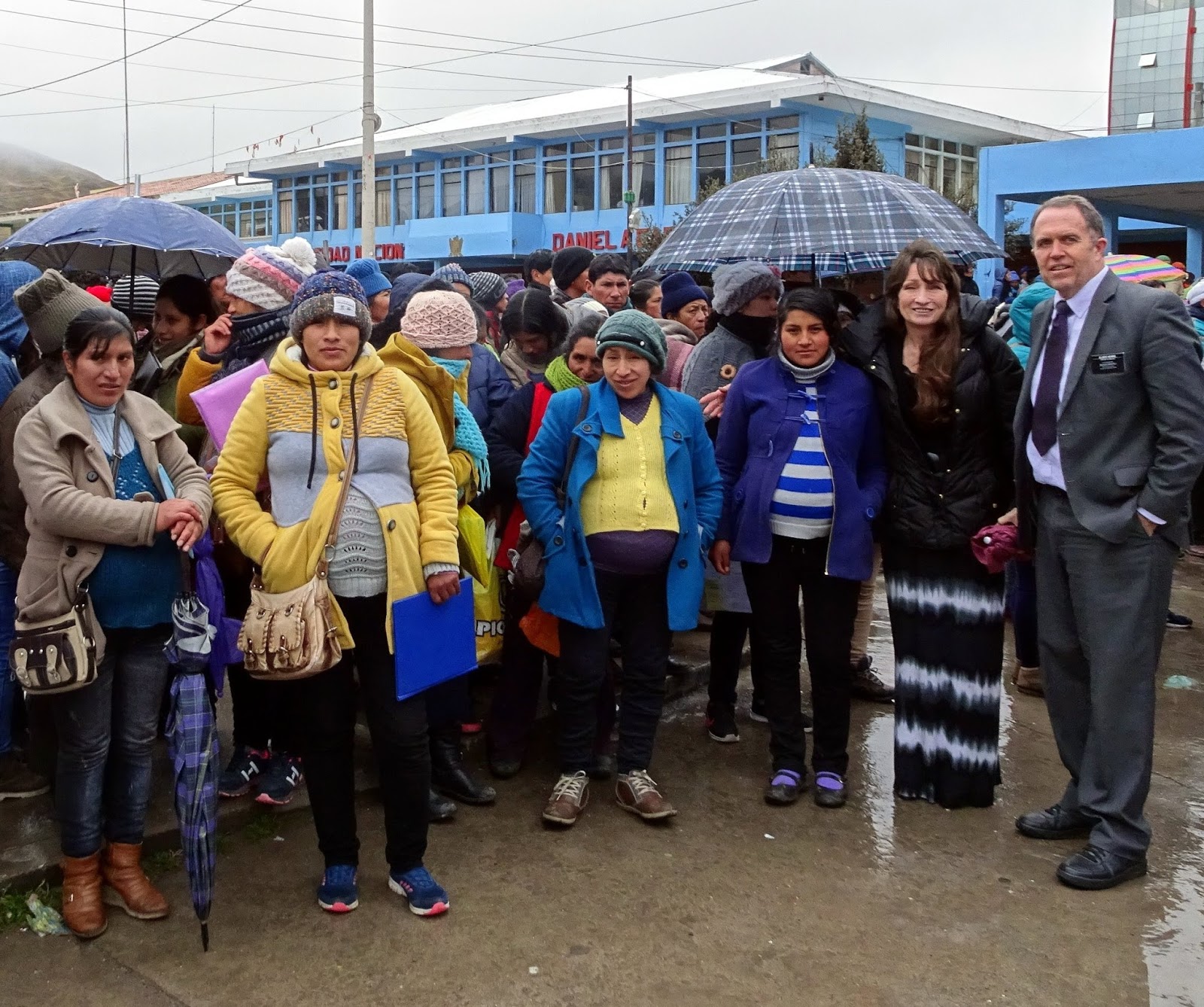
Expectant mothers gathered at the Pasco Health Fair, being held along with the donation ceremony.

In total, our donation included the following items that will be placed in remote health clinics where poor mothers currently have limited diagnostic care:
  • 3 Ultrasound Machines
  • 2 Fetal Monitors
  • Biochemical Blood Analyzer
Currently, without these medical devices, many poor mothers have to spend one or more days waiting in lines to get ultrasounds at an overcrowded government hospital, and most just give up and go home and never complete their checkups until it is too late.

The press always shows up at these events. Here I am being interviewed by four local radio stations all at once - and all in Spanish.

The regional department of health decided to hold their health fair in conjunction with the delivery ceremony. This turned out to be a great idea since it started raining on us and on the equipment. All of the tents for the health fair provided a great escape from the storm that let loose right in the middle of the delivery ceremony.

Rains put a damper on the celebration for a little bit. Thank goodness the health fair had tents setup that helped protect from the downpour.
At the delivery ceremony in Cerro de Pasco with some of the equipment being donated to remote health clinics. Government, health, and church leaders (along with volunteers in their yellow 'helping hands' vests) gathered to celebrate this life-saving donation.

We had been working on this project for about 6 months, including getting Area leadership approval, obtaining bids and purchasing the equipment, working with the health leaders in Cerro de Pasco to develop their plans, and then delivering the equipment. The formal delivery ceremony represented the end of many hours or work. The end result should be an improvement in maternal and newborn health for many years to come.

Journey to Cerro de Pasco


Getting into Cerro de Pasco is a challenge. Due to its extremely high altitude, there is no airport. We first had to fly to Huanuco, spend the night, then have a driver take us early in the morning in his car for 2 hours to get there. Twisting, winding mountain roads are the rule if you want to go anywhere in the Andes Mountains.

Cerro de Pasco sits on the back-bone of the Andes Mountains. We flew to Huanuco and spent the night before the 2-hour drive that got us up to Cerro de Pasco.

The 2-hour drive each way always presents interesting scenes. This was our second trip to Cerro de Pasco. Our first trip in March had many delays caused by boulders falling on the road or herds of alpaca. The traffic jam on this trip was caused by donkeys and sheep.

Traffic jam high in the Andes - donkeys and sheep this time, but no alpacas and llamas (which are sometimes the cause of the jams).

Twisting roads, deep canyons, and sheer drop offs mark any journey into the Andes Mountains. The Andes run the length of South America through six nations.

Surprises lie around every bend. We stopped for this photo-op where a spring was gushing right out of the side of the mountain.

Traditional Women in the Andes


Many women in the the Andes wear traditional clothing. This consists of a hat, shawl, and an unusually wide skirt. Although the dress varies a little from region to region, most of the clothing has these basic components. It is always interesting to observe their outfits.

Typical hats and wide skirts worn by many women in the Andes. The skirts are so wide because they have multiple layers of petticoats to help keep them warm.

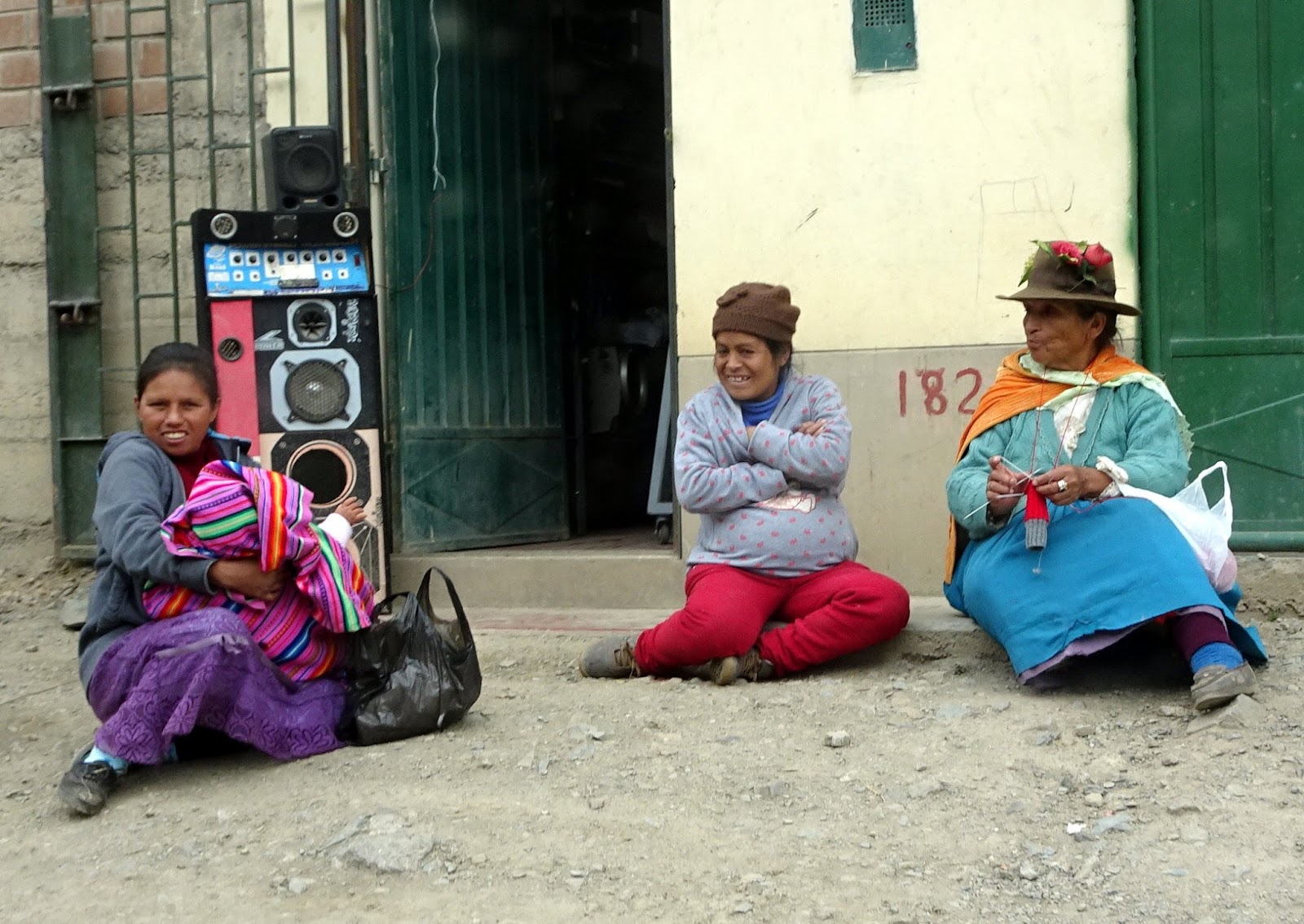
Many traditional Andean women, if they don't wear wide hats, wear tall knitted hats (like the woman in the center). They always carry their babies in bright-colored blankets.

Note that most of these traditional Andean women speak Quechua (rather than Spanish) as their primary language.

Many traditional Andean women like bright clothing. They may wear tights under their skirts and multiple petticoats to further keep their legs warm. 

This traditional Andean woman was wearing subdued clothing as she sat on her porch knitting. We think she was probably mourning the loss of a spouse or child, thus her clothing. 

These women are not too traditional (they left their hats and skirts at home), but they prefer to carry their babies in the traditional way, wrapped in bright blankets on their backs.

Llamas and Alpacas in the Andes


During our drive between Huanuco to Cerro de Pasco, we saw what must have been thousands of alpacas and llamas. For many traditional Andean people, these animals provide their only source of income as they raise them for their fur and meat. You only see these animals at high altitude in the Andes (unless they are being kept in zoos and parks in coastal areas like Lima).

Thousands of domesticated alpaca graze on the steep hillsides high in the Andes.

Alpacas in the front, llamas in the back. Alpacas are shorter, fluffier, and have shorter ears and are often bred with white fur. Llamas are taller with longer ears. Their fur is usually not spun, so llamas appear in more colors.

Mother and baby llama. Note the colorful bands that the owners put through their ears to identify the animals.

This llama even had a bell around its neck.

Brown llama with his white alpaca cousins. Alpaca meat is preferred over llama since it is more tender. Llama meat is most often made into jerky (or "cherqui" as the locals call it).

Huanuco


Before driving up to Cerro de Pasco, we had to fly into Huanuco and spend the night. Huanuco sits at 6,000 ft elevation and is said to have the best weather in the world - it is spring-like year round.

Grand Hotel Huanuco where we stayed - this reminded us of hotels where we have stayed in Spain.

The Huallaga River runs through the middle of Huanuco and is one of the headwaters of the Amazon as it flows down into the jungle.

The valley floor in Huanuco filled up with houses and crops, so the only place to grow was up the side of the mountain.

The Huanuco Cathedral reminded us of being in Spain.


And so the adventure of this trip is now behind us and it is time to move onto our next (of many) projects we are working as we try to improve the lives of those most in need here in Peru.


Sabancaya Volcano, Living in the Dumps, Cars of Peru, and Cieneguilla

3 September 2017

Protection from Volcanic Ash


The Sabancaya Volcano in southern Peru started erupting again, and volcanic ash is now falling over a large swath of Southern Peru, making it very dangerous for people who live in the area.

News photo of Alpacas trotting through the volcanic ash from the Sabancaya Volcano.

The regional government of Arequipa asked for an emergency donation of 5000 breathing masks and 5000 goggles for eye protection. We were able to get this emergency donation ready in just days and send it to Arequipa this past week by means of the Peruvian Air Force. 

Goggles and breathing masks - part of our emergency aid to the volcano victims to keep them safe from all the ash.

It is good to know that we can help out in emergencies like this when the people need it the most. It seems there is always some disaster unfolding here in Peru.

Life in the Dumps


We live in a nice area of Lima, but not everyone is so lucky. This week we drove by a garbage dump, complete with residents. Notice all the poor homes (actually, shacks) built at the edge of the dump on land no one else would live on. Can you imagine the stench?

Living in the garbage dump - not a pretty picture

Look closely to see all the people who make their living combing through trash for things that they can sell just to feed their families. What a tough life! There are far more poor people than rich people here in Peru.

Life in the garbage dump - sorting through trash to make a living. 

Until you see this, you have no idea how many of the world's population live in tough circumstances. You count your blessings when you consider that your house is not sitting on top of a garbage dump.

We are serving the poor here in Peru who live and suffer at the bottom of the heap. Sometimes it is good to remember that not everyone lives the lives we got handed.  

Almost Peruvians


We were handicapped here in Peru for the first 5-1/2 months because we did not have our Peruvian visa ID cards, only our passports. We finally received the ID cards, called 'Carné de Extranjería', which now allow us to use our credit cards and do a host of other things without having to show our passports.

Carné de Extranjería - we are legally in the country with the Peruvian version of our 'green card'.

Having the Carné de Extranjería makes us feel almost Peruvian.

Everyday Traffic Nightmares


Lima has some of the worst traffic in the world. Getting any where in this city of 10 million people takes a lot of time. My memories of Lima will include the many, many hours we have sat at a standstill in traffic.

Typical traffic jam on Avenida Javier Prado - six lanes wide of stopped cars.
One day it took us an hour to get the three miles from our apartment to the mall. We could have walked faster than taking the taxi to get there.

Trip to Cieneguilla


On our day off this week, we went with another senior missionary couple (the Jones from Portland) to Cieneguilla, a resort town about 15 miles away. We went to a place called Mesa de Piedra (table of stone) for a traditional lunch and entertainment - a nice and beautiful escape from Lima for a day.

Beautiful Mesa de Piedra resort in Cieneguilla. Notice the stone tables, hence the name of the place.

Lunch under the thatched roof at Mesa de Piedra with our friends, Elder and Sister Jones
Live entertainment at Mesa de Piedra - a fusion of modern and traditional Peruvian music.

Museo de Automoviles (Car Museum)


On the way to Cieneguilla on our day off, we stopped at the Museo de Automoviles in La Molina. The owner, Jorge Nicolini, came from a very wealthy family and has spent a fortune restoring cars that he found around Peru. What an amazing collection of more than 100 cars!

A fortune spent restoring cars found throughout the country - most were imported into Peru years ago.

1935 Pierce Arrow - it takes a year or more to restore each of these cars.

Pierce Arrow hood ornament

Collectors and car enthusiasts come from around the world to see this collection (which is still in progress). The owner, Jorge Nicolini, is 72 and is still buying more cars to restore, which he finds throughout Peru. We met his 18-year-old son who will take charge of the collection when his dad is gone.
All the cars are in working condition. The owner routinely takes the cars out on the road.

This is how most of the cars arrive for restoration - straight from the junk yard.

Happy Birthday in Peru


Sandy's birthday was Saturday, so we went to Jockey Plaza mall to celebrate. We have been eating Peruvian food for 7 months now, but the only thing Sandy wanted for her birthday was to eat a taste from home - Pizza Hut!

Dinner at the food court at Jockey Plaza, the largest mall in Peru.

Pizza Hut at the mall - a taste of home for a birthday dinner. Sandy, you're not getting older, you're getting better!

Back in the area office, several people found out that it had been Sandy's birthday, so they chipped in and bought a cake, and everyone sang Happy Birthday, but in a Peruvian Spanish version. What a treat!

Birthday party in the Humanitarian Office: (L to R) Michael Trejo, Marshall, Sandy, Lily Davalos, Oscar Sanchez, and Alex Principe.


So we head back to our Humanitarian office for another week of intense service to the poor and needy throughout Peru. We miss our friends and family, but we are glad for the work we are able to do to help those in need.